Where Do You Feel Emotions in Your Body? Body Maps of Emotions and a Body Scan Practice
A study of over 700 people found that each emotion has its own pattern in the body. Learn what the bodily maps of emotions show, what they don't, and try a 10-minute body scan.
When you feel anxious, where do you feel it? Many people describe a tight chest or a knot in the stomach. When we're happy, we talk about feeling "warm inside". These phrases aren't just figures of speech: most of us really do feel emotions somewhere in the body.
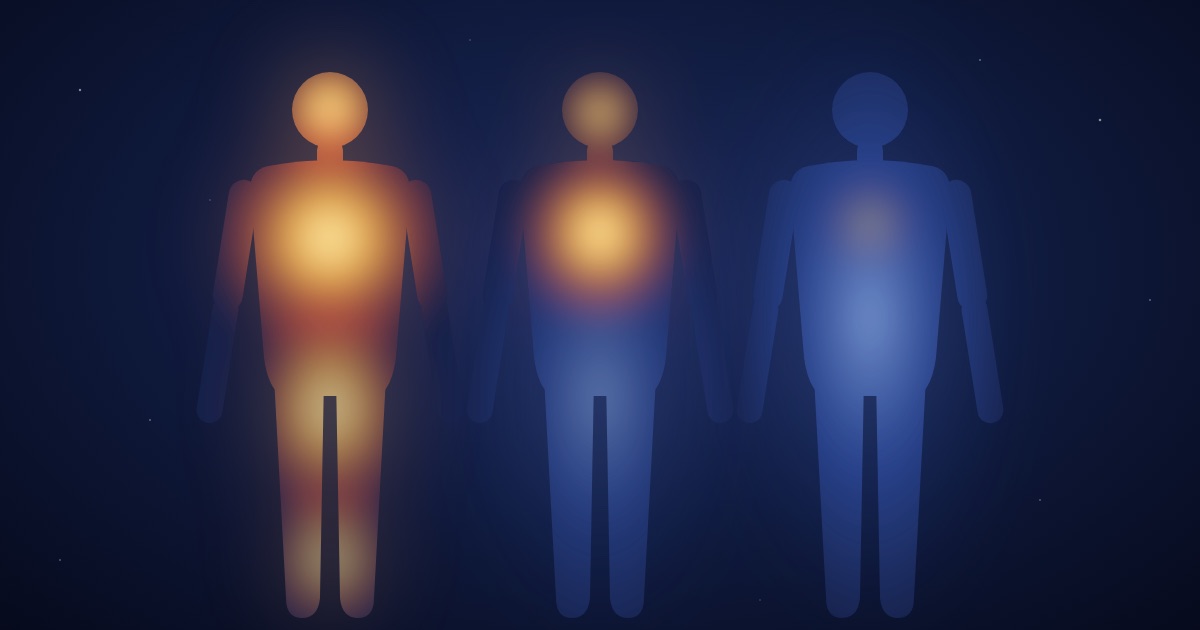
A few years ago a team of Finnish researchers tried to put those sensations on a map. The result is the colorful set of body silhouettes you may have seen on social media, each one glowing yellow and red or fading to blue for a different emotion.
What the "bodily maps of emotions" study did
The study, Bodily maps of emotions, was published in PNAS in 2014 by Lauri Nummenmaa and colleagues at Aalto University. More than 700 people from Finland, Sweden and Taiwan took part online.
The method was simple:
- Participants were shown an emotional stimulus: a word, a short story, a movie clip or a facial expression.
- They then saw two blank body outlines. On one they colored the areas where they felt activity getting stronger, and on the other the areas where it was getting weaker.
- The researchers combined everyone's answers into one map per emotion.
Warm colors mean more sensation; cool colors mean less.
The 14 maps
The study's well-known maps show 14 states. Here is a simplified illustration of them:

They fall roughly into three groups:
States that warm almost the whole body
- Happiness: warm from head to hands and feet; the brightest map of the set.
- Love: similar to happiness, with more focus on the head, chest and stomach.
- Pride: the head and upper body, especially the chest, light up; the legs less so.
States felt mostly in the head and chest
- Anger: the head, chest and especially the arms and hands, as if the body is getting ready to act.
- Fear: the chest and upper stomach.
- Anxiety: similar to fear, centered on the chest, with weaker legs.
- Disgust: the throat, mouth and stomach area, the places we associate with feeling sick.
- Surprise: the head and upper chest, with weaker legs.
- Shame: a warm face and head, some chest and stomach, with weaker limbs. Think of blushing.
- Envy: the head and the chest and stomach area; the rest of the body stays fairly quiet.
- Contempt: mostly the head and face, a little in the chest; one of the faintest maps.
States that leave the body low in energy
- Sadness: some activity in the chest and head, with weaker arms and legs.
- Depression: most of the body, especially the limbs, feels cool and low in energy.
- Neutral: almost no strong areas at all; it's the baseline for the others.
Even more interesting, the maps were similar for the Western European and East Asian groups, so these patterns weren't tied to one language or culture.
What the study doesn't show
On social media the image is often shared with headlines like "Scientists prove emotions live within your body". That's not quite accurate:
- The data is self-reported. Nobody measured body temperature or organ activity.
- The maps are averages of hundreds of people. You may feel the same emotion somewhere else, and that's completely normal.
- The maps are not a diagnostic tool and can't be used to read anyone's state.
What the study does leave us with is simpler and, we think, more useful: emotions aren't only thoughts, they also leave a trace in the body. And paying attention to the body can sometimes tell us how we feel before the mind catches up.
Body scan practice: draw your own map
The body scan is a common mindfulness practice. You slowly move your attention from one part of the body to the next and simply notice what's there, without trying to change anything.
- Sit or lie down comfortably. Close your eyes or lower your gaze.
- Take a few easy breaths. No need to control them; just notice them.
- Start at the head. Forehead, eyes, jaw. Tense or relaxed? Warm or cool?
- Move down: neck and shoulders, then the chest. Any pressure, heaviness or lightness?
- Stomach: notice it move with your breath. Any knots or flutters?
- Arms and legs: all the way to your fingertips and toes. Warm or cold? Energized or tired?
- Finally, sense the whole body at once. Ask yourself: "Where do I feel the most right now?"
If your mind wanders off, that's fine. Whenever you notice, gently come back to the part of the body you were on.
Afterwards you can draw a simple figure on paper and color in the areas you noticed. That's your map for today, and it may look different tomorrow.
Body scan with Calm
The button below opens a 10-minute session with no background sound and the gentle "soft kaleidoscope" visual. The start and end chimes let you stop watching the clock and just pay attention to your body.
If you're new to meditation, read our meditation for beginners guide. And if your chest or stomach feels tight, a few rounds of box breathing before the body scan can help you settle in.
Frequently asked questions
Do emotions really live in the body?
The Nummenmaa study found that people feel each emotion with a fairly distinct pattern of bodily sensations. That means emotions come with physical sensations, not that an emotion "lives" in a particular organ.
What if my map looks different from the study's maps?
That's completely normal. The maps are averages of hundreds of people, and everyone's body and experience are different.
How long should a body scan take?
Anywhere from 3 to 45 minutes. Five to ten minutes is plenty to start with.
What if I don't feel anything during the body scan?
That's an observation too. "I don't notice anything in particular" is a valid answer, and with practice subtler sensations become easier to notice.