
Schulte Table Focus Exercise: Find the Numbers in Order (Free, Online)
What a Schulte table is and how to use it as a short focus exercise. Steps, the rotating-rings version, common mistakes, and what research says about mental training games.
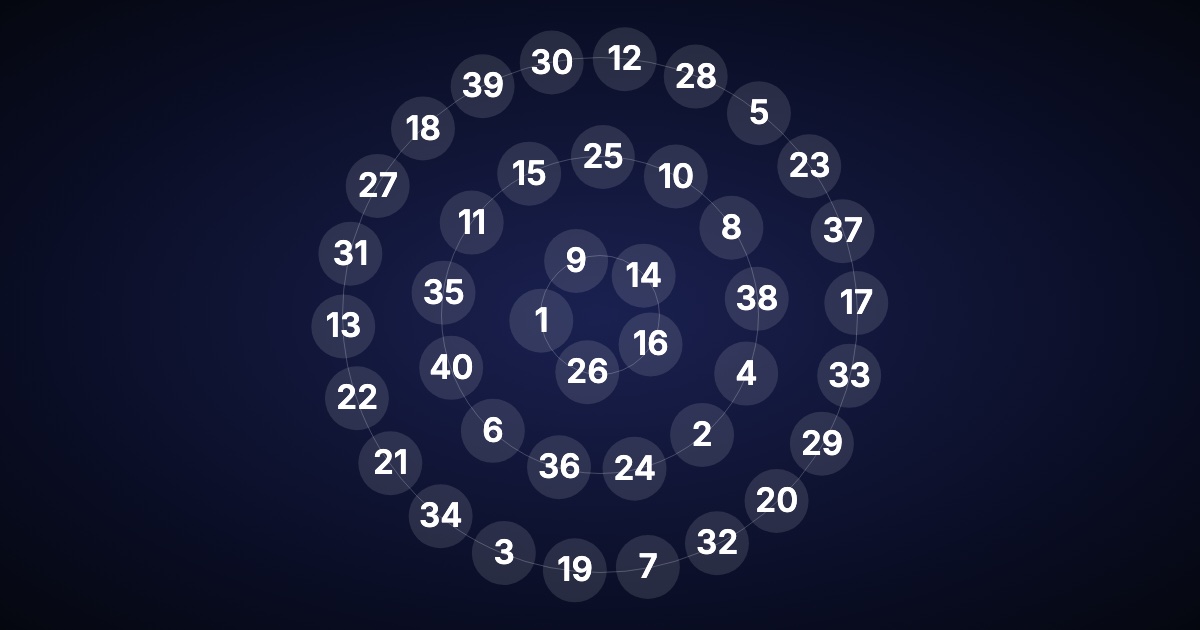
A Schulte table is a simple attention exercise: the numbers 1 to N are scattered on a page, and you find them in order, starting from 1. It sounds easy, but your eyes have to search while your mind holds the next number and the order, and for a minute or two your attention is fully busy. This guide covers what the exercise is, how to do it, how the rotating-rings version differs, and what the research does and doesn't say.
What is a Schulte table?
A Schulte table is usually a square grid (for example 5 by 5) with the numbers 1 to 25 placed in random order. It is named after Walter Schulte, a German psychiatrist, and has long been used in attention exercises and sometimes in speed-reading practice. All you need is a table and a timer.
A newer version that circulates widely puts the numbers on several concentric rings instead of a grid, and the rings slowly turn. The rule is the same, but the target moves, so you have to find it again.
What does it train, and what doesn't it?
The exercise asks you to do three things at once: move your eyes across the screen, keep the target number in mind, and ignore everything else around it. That is why many people call it a focus exercise.
Still, it's worth keeping expectations realistic:
- Reviews of "brain training" find that practice usually improves the trained task itself, so you get faster at finding numbers (Simons et al., Psychological Science in the Public Interest, 2016).
- The same review concluded that evidence is lacking that these gains carry over to everyday tasks such as focusing while reading or working.
- No study shows that Schulte tables or rotating rings have a particular effect on focus or health for everyone.
Honest summary: it's an attention game, not a treatment. If you enjoy it and your mind feels a little more gathered afterwards, that's enough. We don't promise more than that.
How to do it
- Sit comfortably and look at the screen from your usual distance.
- Start at 1 and look only for the next number.
- If you can, keep your gaze near the center and find numbers with peripheral vision. If that's hard, look around freely.
- Tap each number as you find it and move on to the next.
- If you tap the wrong one, just try again without blaming yourself.
- At the end, check your time and repeat a few times. The aim is to beat yesterday's you, not other people.
Still grid or rotating rings?
- Still grid (Schulte): the better start. No motion, just search and order.
- Rotating rings: try it once the grid feels easy. Begin at "slow" and speed up only if you want to.
How many numbers?
20 is a good starting point. You can go up to 100. On a small phone screen 100 numbers get tiny, so 20 to 60 is more comfortable on mobile.
Common mistakes
- Rushing. Too much speed means more wrong taps and just makes the exercise tiring.
- Chasing a record. Your best time is a simple marker, not a test. A slower day is fine.
- Long sessions back to back. A few short rounds beat one long session that tires your eyes.
- Dark room with a bright screen. Balance the room light and the screen brightness.
- Fast rings from the start. Begin with the still grid or a slow speed.
Safety notes
- If the moving rings make you dizzy, nauseous, give you a headache or strain your eyes, stop and choose "Still".
- If you are sensitive to motion on screen, use the still grid only.
- Every few minutes, look away from the screen at something far away.
- This exercise doesn't replace an assessment or treatment for attention problems. If you're worried about your focus, talk to a doctor or specialist.
Try it in Calm
In Calm you choose the exercise (rotating rings or Schulte table), how many numbers (20 to 100) and the rotation speed. The timer is optional and your best time for each setup is stored on your own device. The button below opens 40 numbers on slow rings. If you prefer a still grid, this link opens 25 numbers on a still grid.
FAQ
Does a Schulte table improve focus?
There's no strong evidence that practice transfers to everyday tasks. What you usually see is getting better at the exercise itself. As a short, calm game, it's harmless to try.
Should I keep my eyes on the center?
No need. Holding your gaze at the center and searching with peripheral vision is a suggestion from traditional exercises, but if it's hard, look around freely.
How often should I do it?
There's no set number. A few short rounds (one or two minutes) when you feel like it is enough. If your eyes get tired, stop there.
Why do the numbers rotate?
Rotation makes it a bit harder because the target isn't fixed. If you don't want that, set the speed to "Still" or choose the Schulte table.
Further reading
- A mindful check-in every two hours: a simple chime to remember short pauses.
- 2-minute breathing exercise: three quick techniques when you're short on time.
- Box breathing: a four-equal-steps breathing exercise.
- Meditation for beginners: attention on the breath in silence.